You hear it everywhere. AI agents are coming, jobs will change, the world will flip. Reels, YouTube, LinkedIn, all of it. But ask most people one simple question, "what is an AI agent, actually," and they freeze. It is a smart ChatGPT. It is automation with AI on top. Honestly, I do not know. Let us fix that today.
01. The hype, and the real question
start from zero, no PhD words
When I first stepped into this space, the explanations were either PhD level or so vague that nothing landed. I only got clarity by building real systems for real clients, watching agents do actual work in actual businesses.
So here is the deal. I will explain it from the ground up, in plain words, in the Indian context, because what the US crowd shows you often has nothing to do with our market, our businesses, or our jobs.
A chatbot answers you. An agent does the work.
02. Myth 1: it is a smart chatbot
chatbot asks, agent decides
The most common confusion. You open ChatGPT, type a prompt, get an answer, and think that is an agent. It is not.
A chatbot asks you for every little thing. An agent asks you for one thing: the goal. Then it goes and gets it done. The chatbot hands you instructions. The agent does the task.
Simple test: if it only talks back, it is a chatbot. If it takes a goal and produces the finished work, it is an agent.
03. Myth 2: every automation is an agent
fixed steps vs real decisions
Second myth. The moment something happens automatically, people call it an agent. Email arrives, drop it in a sheet, ping Slack. That is automation. Fixed steps. Same thing every time. Nobody is making a decision.
An agent looks at the situation and decides. Complaint, push it to the CRM. Normal query, auto reply. Spam, ignore it. A different call for every input. That judgment is the whole difference.
04. Myth 3: it is JARVIS
narrow and useful, not magic
The funny one. People watch flashy marketing videos and expect an agent to book their travel, refill the fridge, and run their whole life. In 2026, we are not there.
Today's agents are strong on narrow tasks. Support, research, reports, lead handling. Real work, real value, but scoped. Full JARVIS is not here yet. That is the honest answer.
05. What an agent actually is
goal, planning, tools, loop
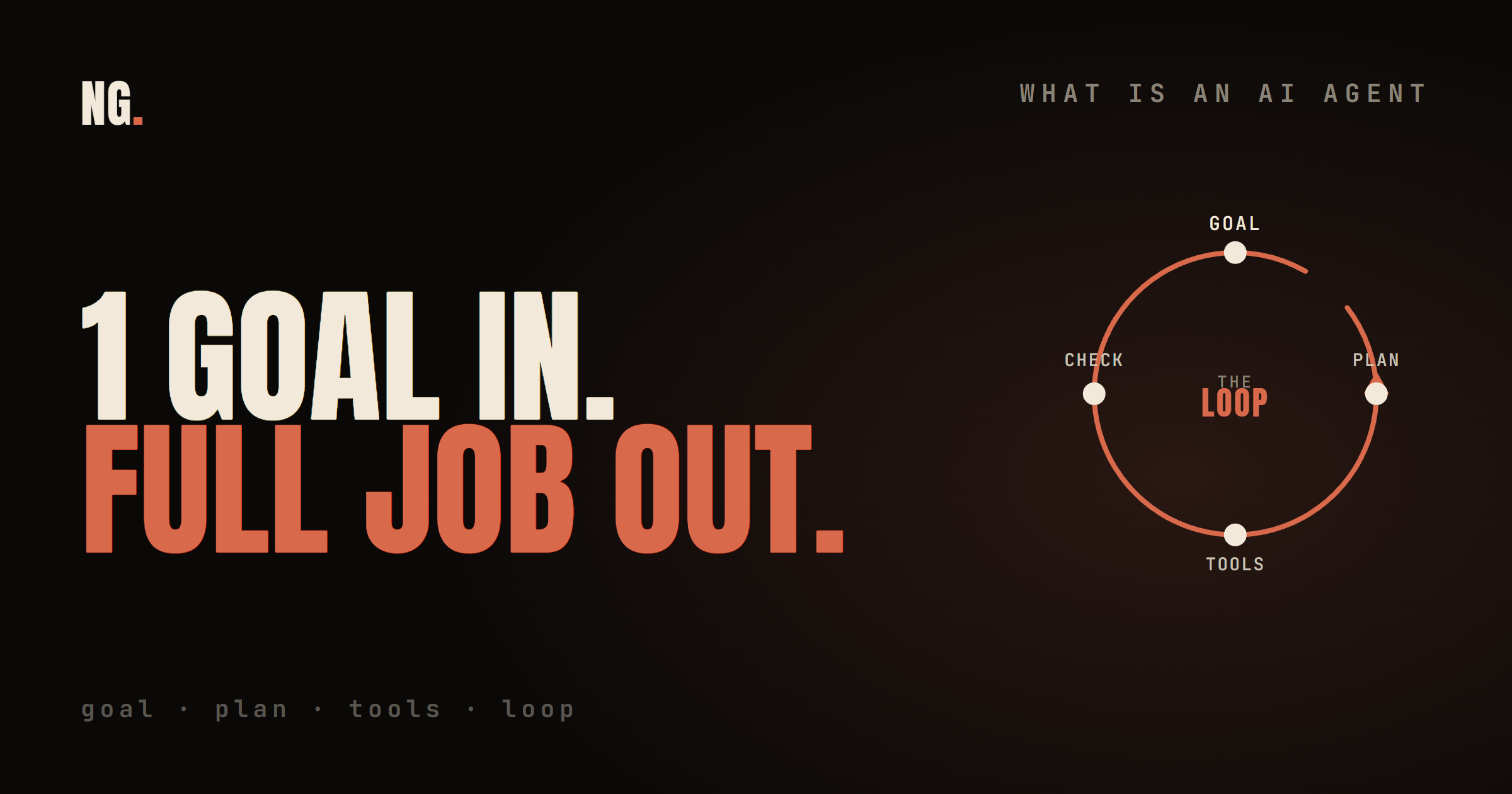
Myths cleared, here is the real definition. An AI agent is four things working together.
Goal. You tell it what you want. Planning. It works out the steps itself, you do not spell them out. Tools. It uses whatever it needs, web search, email, a database, a calculator. Loop. It does the work, checks if it is done, and keeps going until it is.
Someone on Reddit put it perfectly: it clicked when they saw the model choose a tool, the result go back to the model, and the model decide what to do next. That is the loop. That is the agent.
06. Example: the job application
one goal, fifty companies
Definitions do not stick without a real example. You are a college student. You have to apply to 50 companies. Every one has a different form, a different cover letter, different custom questions. Alone, that is two weeks of your life.
You give an agent one goal: get my application ready for this job link. Watch what it does.
It reads the description, tailors the cover letter to your resume, drafts the custom answers, checks the match, and improves if it falls short. You get a finished application and do one thing. Submit. That is autonomous execution. Fancy word, simple meaning: it thinks and does the work itself.
07. Example: the inbox helper
one goal, a hundred emails
Second example. You give one goal: manage my inbox. The agent reads each email and decides. Complaint goes to the CRM. A real query gets a drafted reply. Spam gets ignored.
Ask a chatbot the same thing and it tells you how to do it. The agent just did it. Same difference as before, now on your inbox.
08. Where this helps in India
who this is actually for
Now the practical part. Where does this actually earn its place for you here.
| If you are a | Give the agent |
|---|---|
| College student | Job applications, internship research, resume tailoring |
| Freelancer | Client emails, proposals, follow ups, inbox triage |
| Small business owner | WhatsApp leads, basic customer queries, first replies |
India's first real wave of agents lands right here. The junior level, repetitive, manual work gets handled, and people move up to the work that actually needs a human. The real question is not what an agent is anymore. It is where you fit in this picture.
09. How I actually run one, cheap
Claude for the brain, free tools for the hands
This is the part nobody tells you, and it is how you get great output without burning money. Do not run the whole thing on the most expensive model. Split the work.
Use a top model like Claude for the thinking: the plan, the structure, the architecture of the agent, the hard reasoning. Then push the execution, the repetitive runs, the bulk calls, onto free or cheap models. Brain on Claude, hands on the free stack. You keep the quality where it matters and cut your token bill everywhere else.
Here is where to get the free hands. Real free tiers, no credit card to start. Limits change, so check the provider before you lean on the numbers.
| Free source | Rough free limit | Best task for it |
|---|---|---|
| Google AI Studio | ~1,500 requests a day, huge context | Reading long docs, the understanding step |
| Groq | ~1,000 requests a day, 300+ tokens/sec | Fast execution loops, quick replies |
| OpenRouter | 20+ free models, one key | Trying models before you pay |
The move: architect the agent once with the smart model, then route every easy or repeated step to Groq or Gemini free. Same result the reader feels, a fraction of the cost. That is doing it real, not just paying for the app.
10. Where to start, and the FAQs
skip the rabbit hole
One clear warning first. LangChain, AutoGen, multi agent frameworks, do not grab these yet. That is a rabbit hole, and you will spend forever before anything works.
The right start is simple. One tool, n8n or Make. One goal, a job application or an inbox helper. One loop, goal to tool to result to check. n8n is open source, so you can self host it free and read the whole thing on GitHub.
Do I need to code? Not at first. Start no code with n8n or Make. Code is an option later, not a requirement. Will free tools work? For learning the concept, yes. For real deployment you shift to an API, and the free tiers above are exactly where you begin. Will agents take my job? The repetitive work, yes. Complex decisions, creativity, client handling, still you. In India jobs will not vanish, their shape will change.
One line to keep. An AI agent takes your goal, plans by itself, uses tools, and loops until the work is done. That loop is the whole thing. Now pick one repetitive task in your week and hand it over.
// Free newsletter
I send out guides like this every week
Real setups, real sources, no hype. Drop your email and I'll send you the next one.